
Inside the Crypto Sector
The Sell Pressure Is On: What’s Next for Bitcoin and Ethereum?


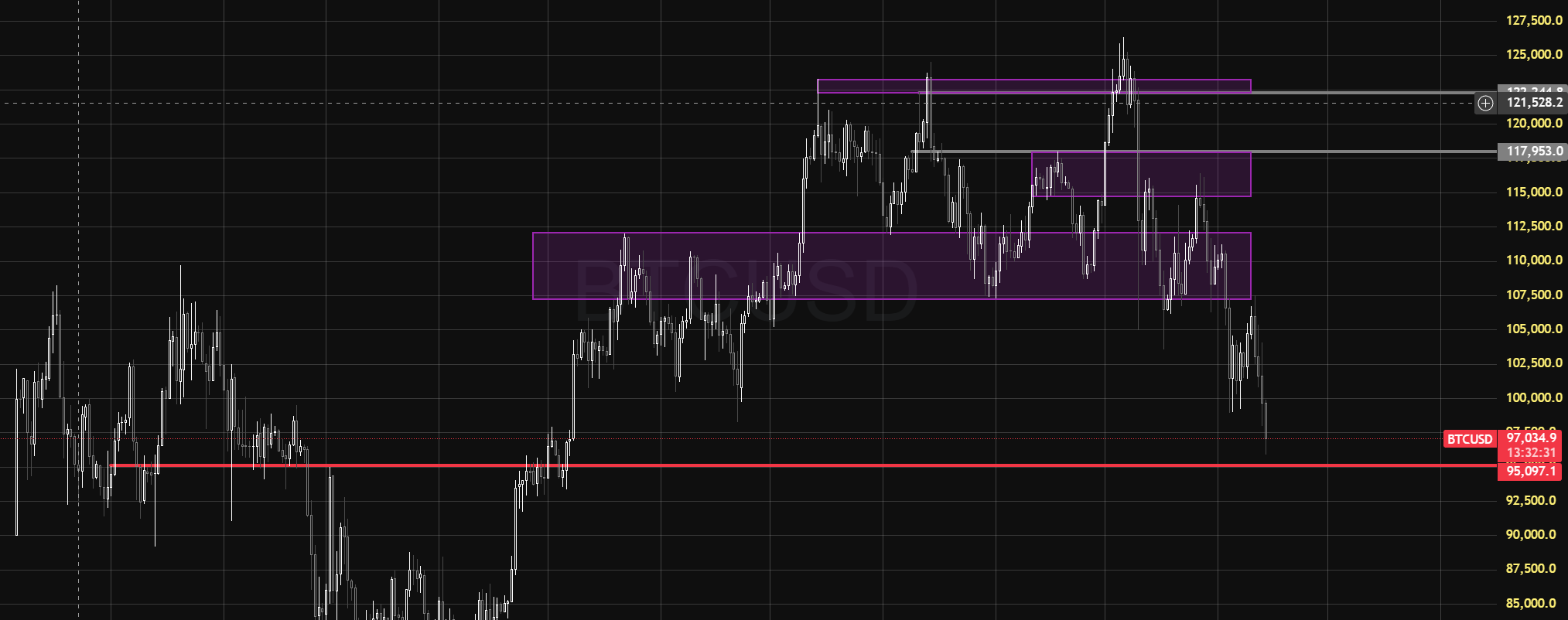
Bitcoin’s correction continues to weigh on the digital asset complex. The asset is now down roughly 23% from its late-October highs, trading near $96,800, which leaves year-to-date performance effectively flat. As Bitcoin retraces, digital asset–tied companies (DATs) like MicroStrategy (MSTR) are catching the downside, with MSTR now 54% off its yearly highs.
Could this sell pressure continue? Possibly — but the mechanics offer nuance. Earlier in the year, we discussed on X Spaces a market-neutral arbitrage play that institutions were exploiting: long BTC, short DATs. That structure was available through leveraged ETFs and synthetic exposures, yet as of now, that arbitrage window has largely closed or at least looks far less appealing on a risk–reward basis. The implication? Much of the mechanical downside pressure may already have played out.
Across to Ethereum, ETH is down nearly 10% over the past 24 hours, currently at $3,170. Shares of Bitmine, an Ethereum-focused company, have mirrored the drawdown, sitting at $36.23 in pre-market trading. Negative ETF flows echo this pattern:
Spot Bitcoin ETFs saw net outflows of $870 million on November 13 (ET) — the second-largest day on record.
Ethereum ETFs recorded $260 million in outflows, marking the third consecutive day of redemptions.
Interestingly, U.S. spot Solana ETFs bucked the trend with $1.49 million in inflows.
Policy and Institutional Developments
U.S. regulatory clarity takes shape. Treasury Secretary Scott Bessent announced new rules enabling crypto ETPs to stake assets and distribute rewards to retail investors under structured safeguards. This includes single-asset trust mandates, SEC-approved liquidity plans, and independent staking arrangements. The introduction of a “safe harbour” model could set a precedent for how staking is formalised in public markets.
In Brazil, the central bank introduced a comprehensive crypto licensing regime requiring capital reserves between 10.8 and 37.2 million reais, depending on activity type — bringing stablecoins and cross-border transfers under FX law with a $100,000 transaction cap.
Meanwhile, NH NongHyup Bank in South Korea launched a proof-of-concept with Avalanche, Mastercard, and Worldpay to automate tourist tax refunds through stablecoin settlements — showing how TradFi rails are actively testing on-chain transaction models.
Exchange and Corporate Moves
Coinbase continues to make headlines on multiple fronts. The exchange launched a new platform giving individual investors early access to tokens prior to official listings — starting with Monad, a high-performance blockchain. In parallel, Coinbase Business went live in Singapore in partnership with Standard Chartered, enabling real-time stablecoin settlement for SMEs. In corporate restructuring, Coinbase plans to relocate its legal registration from Delaware to Texas, citing improved innovation incentives and regulatory alignment.
On the ETF front, Canary Capital’s Spot XRP ETF debuted on Nasdaq with standout performance — $245 million in day-one volume — officially the largest new ETF launch of 2025. The Bitwise Chainlink ETF (CLNK) also secured DTCC eligibility, marking another step in crypto ETF mainstream adoption.
Elsewhere:
Tether hired two senior HSBC traders as it expands its $12 billion gold reserves, signalling ambitions to become a bullion heavyweight.
Lighter, an Ethereum L2, raised $68 million at a $1.5 billion valuation led by Founders Fund and Ribbit Capital.
Republic Technologies (CSE: DOCT) secured $100 million in zero-coupon convertible notes to expand Ethereum staking operations.
YZi Labs (formerly Binance Labs) made its first biotech bet, backing Renewal Bio, a regenerative medicine innovator using patient-derived DNA to create custom tissues.
Central Banks, Regulation, and Infrastructure
Momentum is building across the institutional landscape:
The Czech National Bank added Bitcoin to its official balance sheet as part of a $1 million pilot portfolio alongside a USD stablecoin and a tokenised deposit.
JPMorgan officially launched JPM Coin on Coinbase’s Base network, extending 24/7 on-chain settlement to corporate clients, including Mastercard and B2C2.
The FDIC is developing “tokenised deposit insurance”, clarifying legal treatment for tokenised deposits versus stablecoins.
The FASB is exploring new standards for derecognition of transferred crypto assets — potentially the next leg of formal accounting rules post-2023.
Corporate Earnings and Market Structure
Circle’s Q3 earnings underscored the growing role of stablecoins in global liquidity. USDC circulation hit $73.7 billion, with net income rising 202% year-over-year to $214 million. The company also revealed testing for an Arc testnet and signalled plans for a native token, prompting further accumulation from Ark Invest.
Marathon Digital’s CEO Fred Thiel warned of tightening mining margins as rising energy costs meet post-halving economics. Firms with low-cost energy or HPC pivots may endure, while high-expense miners could exit before 2028. Similarly, Bitfarms is winding down mining operations to pivot entirely to AI and HPC infrastructure, reflecting a wider compute monetisation trend across former mining entities.
Broader Narrative
Despite near-term weakness in digital asset pricing, institutional momentum persists across both capital markets and infrastructure layers. ETFs are maturing, stablecoins are finding formal footing within banking systems, and regulators are increasingly drawing distinctions between blockchain-native and tokenised financial products.
The next phase may not revolve around speculative flows but around regulatory clarity and infrastructure integration — elements that underpin sustainable adoption rather than volatility-driven rallies.